|
|
|
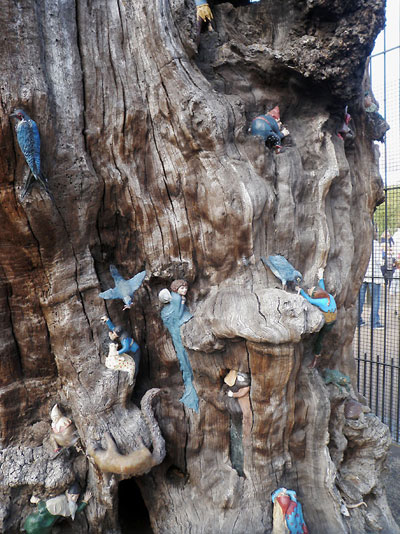
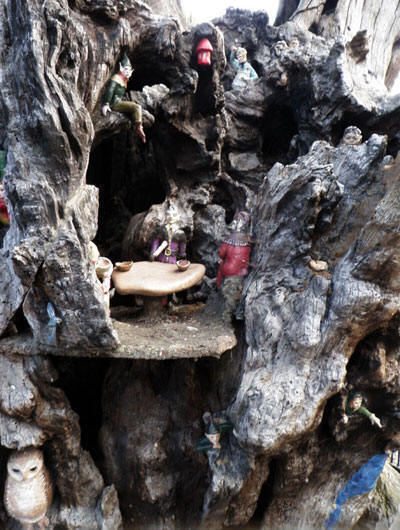
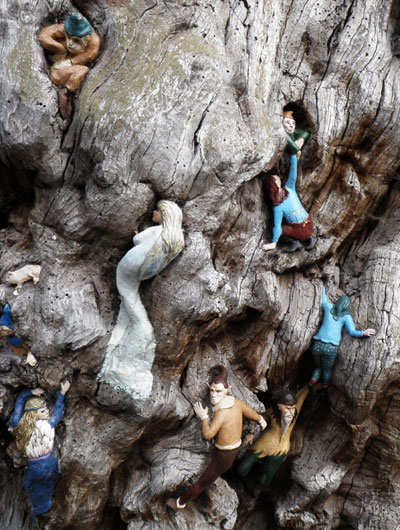
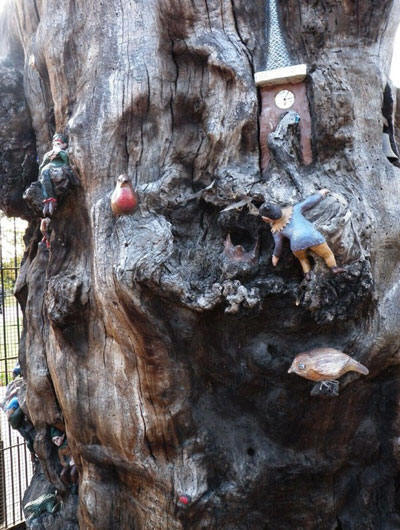
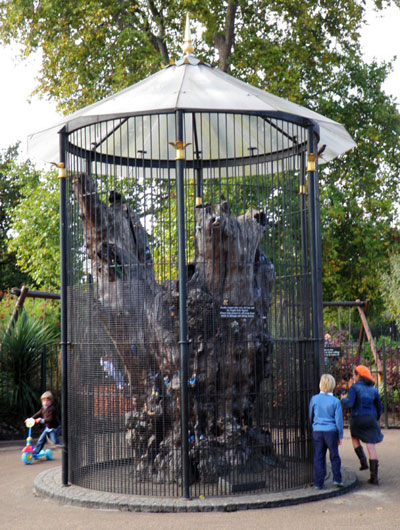
This oak, made and designed by Ivor Innes from an ancient oak, was a gift of Lady Fortescue in response to the Lansbury Appeal. The tree, originally from Richmond Park, is a hollow log which Innes was instructed to carve to look as though gnomes and small animals were living in the bark. Following its move to Kensington Gardens in 1928 Innes spent two years working on the carvings. It was restored in 1951 and again in the mid 1960's by Spike Milligan, the comedian. In 1996/7 Milligan led a successful campaign to raise money to have it restored again. In 1997 it was listed Grade II. The oak is now in good condition and protected by a metal cage with a roof. It is located In Kensington Gardens next to the cafe and Princess Diana Children's Play Area a few yards from the gate on Bayswater Road and close to Queensway Tube Station.
DEPARTMENT
FOR CULTURE, MEDIA AND SPORT, PRESS RELEASE DCMS170/97 THE
ELFIN OAK - 'HOME OF FAIRIES, GNOMES, The Little People will have particular cause for revelry and frolicking in Kensington Gardens tonight. Wookey the witch, Huckleberry the gnome and Grumples and Groodle the elves have today become the proud inhabitants of one of England's most unusual listed buildings. The Elfin Oak of Kensington Gardens has been added to the list of buildings of special architectural or historic interest following a recommendation from English Heritage. It has been listed in Grade II. Announcing the listing of the Oak, Heritage Minister Tony Banks said: "The Elfin Oak is a wonderful curiosity, loved by Londoners and visitors alike. It also has considerable historic interest. Sculpted by children's book illustrator Ivor Innes between 1928 and 1930, the Oak belongs firmly to the late Victorian interest in Little People which culminated in J M Barrie's Peter Pan. The Oak complements the statue of Peter Pan by Sir George Frampton which Barrie erected in 1912. Together, the two sculptures make Kensington Gardens very much the world capital of fairies, gnomes and elves." The gnarled oak stump came originally from Richmond Park and was thought to be some 800 years old when it was moved to Kensington Gardens in 1928. Over the next two years it was worked on by artist-illustrator Ivor Innes, who covered it with brightly-painted animals, elves and fairies, mostly carved from the oak, others probably fashioned from plaster. The tree depicts the world of the Little People, of Wookey the witch, with her three jars of health, wealth and happiness; of Huckleberry the gnome, carrying a bag of berries up the Gnomes' Stairway to the banquet within Bark Hall, of Grumples and Groodles the Elves being woken up by Brownie, Dinkie, Rumplelocks and Here and there stealing eggs from the crows' nest. Situated next to the children's playground by Black Lion Gate, the Elfin Oak was installed as part of George Lansbury's inter-war scheme of improvements to public amenities in London. He was responsible for the foundation of the Serpentine Lido in 1931, the equipping of the playground between 1923 and 1932 and the opening of a sandpit and octagonal shelter, as well as the Oak, in 1930. Spike Milligan has played a key role in ensuring the Oak's survival. He funded restoration work in the mid 1960s, and 30 years later came to its rescue again by launching a fundraising campaign for a new restoration, which was completed in June 1997. The Elfin Oak of Kensington Gardens, the children's book which Ivor Innes published with his wife Elsie in 1930, describes how "for centuries now it has been the home of fairies, gnomes, elves, imps, and pixies. In the nooks and crannies they lurk, or peer out of holes and crevices, their natural windows and doorways. It is their hiding-place by day, their revelry place by night, and when the great moon tops the bare branchless tree the Elfin Clans come out to play and frolic in the moonlight." (Elsie Innes, The Elfin Oak of Kensington Gardens, Frederick Warne & Co, 1930).
Click
on this link for more information on
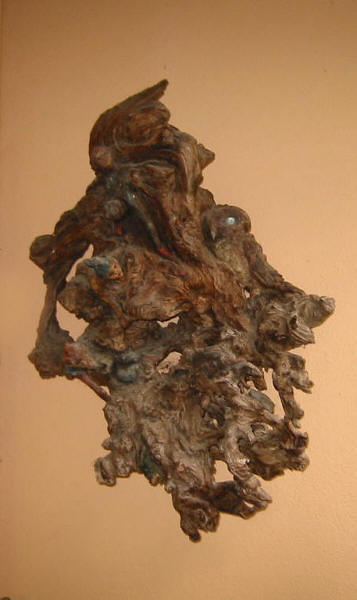
Lady Fortescue's own 'Elfin Oak'
Winifred Fortescue's 'Elfin Oak'
Pictures - M.A. King, P.Riley | |||||||