|
The Story of
Hélène Vagliano
Légion d’Honneur, Chevalier; Croix de Guerre avec Palme; Medaille de
la Résistance.
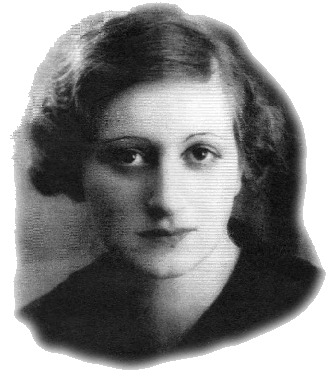
Large dark eyes look out, under
arched brows, from an oval face. The look is serious, but the
subject of the photograph could not have known what life held in
store for her. She is Hélène Vagliano and her story should not be
forgotten.
Hélène’s parents were part of a
large and respected Franco-Greek background of bankers and merchant
ship owners with strong links to England. There is a Vagliano tomb
in West Norwood cemetery in London. Hélène was born in Paris in 1909
but the family, her father Marino, her mother Danaë, Hélène and her
two brothers, moved to England, living at The Grange at Ascot near
Windsor, where they had one of their elegant houses and admired
gardens. Much later, in very different circumstances, Danaë
Vagliano would remember these gardens and the lake ‘on which floated
swans, as white as snow’.
In 1924 Hélène’s parents moved to
Cannes, in the south of France, and Hélène (always Elaine to her
English friends) became a boarder at St. George’s School in Ascot.
At this private all-girls school, she was successful and popular.
Her serious expression in her photograph belies her high spirits and
mischievious sense of humour. She was a model pupil, a prefect, a
promising pianist and played goal in the 1st lacrosse
team. She spoke French fluently but, as the result of her schooling,
would always speak it with a pronounced English accent. A fact which
would count against her in the future.
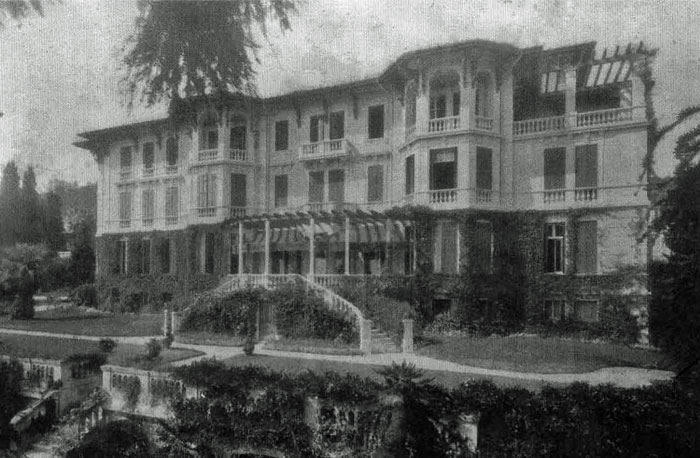
Once in Cannes the Vaglianos
bought land in the Californie district and here they built the
impressive Villa Champfleuri, where Danaë created a garden of such
importance it is now under a preservation order. Here there were
flamingos on the small lakes, rather than swans.
In 1927 Hélène left her school in
Ascot and joined her family in Cannes, where her parents had already
settled comfortably into expatriate life. Hélène’s father, Marino,
was a champion golfer and President of the prestigious Golf Club at
Cannes-La Napoule (during the German occupation in the last months
of the second world war, this golf course would be planted with
around 2,000 land mines). Danaë became captain of the French Ladies’
Golf Team, and the international Vagliano Trophy still exists in her
name. From here, living the life of a typical, privileged, young
Riviera girl of the 1930s, Hélène regularly sent news of her
escapades to the Alumni magazine of her old school in England. She
bought herself a speed-boat ‘it’s tremendously thrilling, especially
turning corners’, skied and mountaineered with her brother which
‘gave the guide many white hairs’. She trained tortoises ‘one gets
almost breathless chasing them’ and generally enjoyed herself
thoroughly. In the midst of this gaiety she also translated articles
into Braille for periodicals for the blind and became involved in
the activities of the British community in Cannes, becoming Brown
Owl of the 1st Cannes Pack of Brownies. She was also a Scout Leader
with the Cannes Scout Group and is the only woman to be recorded in
The Scout Association's Second World War Roll of Honour.
All this would change with the
declaration of war in September 1939, followed by the dreary months
of the Phoney War or Drôle de Guerre. The expatriate
community along the coast, particularly in Cannes, sprang into
action. Numerous aid programmes were launched and their letter
headings sport the names of many of the great and good of the
Riviera at that time. Hélène and her mother joined the committee of
the Military Canteen at Cannes station, set up to provide
refreshments for the troops being sent to defend the frontier with
Italy. But, several months later, as the German army breached the
border from Belgium and swept across France, the vast majority of
these expatriates fled the Riviera.
By July 1940 France had
capitulated, making a prisoner of war of one of Hélène’s brothers,
and the south had fallen under the yoke of the Vichy government.
Firmly anti-Nazi and anti-Vichy, the Vaglianos stayed, wisely
keeping a low profile. By 1941 Hélène had become the local organiser
for the Social Services Department of the Maison du Prisonnier
in Cannes – a prisoners’ aid organisation which cared for the
families and orphans of lost and imprisoned soldiers. As the war
progressed, and virtually everyone became permanently hungry, Hélène
would, each week, take groups of the children to restaurants where
they could have a rare good meal. She was recognised as being as
generous with her money as with her compassion and known never to
doubt the final victory of the Allies.
In 1943 the oppression in the
south increased as the Allies swarmed into North Africa, Italy
capitulated and the German Army occupied totally the ‘Free’ Zone of
Vichy France. For Hélène aid work was now not enough and, unknown
to her parents, she joined the Resistance. All her physical and
intellectual energy had now found a cause. Although her mother would
say later ‘she worked with the English’, Hélène is not on the list
of agents of the Special Operations Executive. However, she seems to
have been involved with more than one scheme to help the Allies. As
well as working with a local Resistance group or reseau,
which helped the hunted to escape from France through Spain, she
became an agent for the
Bureau Central de
Renseignments et Action
(BCRA) operating out of London. This was an organisation created, at
the request of Winston Churchill, by De Gaulle’s Free French
government-in-exile, to
inform the Allies of enemy movements and prepare for liberation.
Hélène’s group, led by Dr Paul Schmierer, was Tartane-Massena
working on the Riviera, and in it her code name was Veilleuse.
She also became a ‘letter box’ for the Allies and, equipped with a
radio, sent and received messages and kept her control informed on
the activities of the German Army, for by now the Gris-Verts (called
after the colour of their uniform) were anticipating an invasion
along the coast. The slightly built Hélène was frequently to be seen
on her bicycle in and around Cannes, with messages hidden in the
handlebars and sometimes, rather recklessly, her radio camouflaged
in the rear basket.
On 28 July 1944, at a time when
hope was beginning to grow into certainty for an Allied invasion, a
car drew up outside the building where Hélène worked. In it were a
group of Frenchmen, members of Jacques Doriot’s Legion des
Volontaires Français Contre le Bolchévisme headed, as was usual,
by a German officer. This organisation, virulently
anti-Communist and arch-collaborators, frequently worked cheek by
jowl with the local French Milice. The latter group, operating
virtually outside the law, was composed of Frenchmen dedicated to
hunting members of the Resistance. Denounced by an arrested woman,
whose son she had helped to escape, Hélène was taken away. Later on
the same day, at the Villa Champfleury, her parents were roughly
arrested as hostages, in a move designed to pressure Hélène into
betraying her fellow Resistants.
The torture of Hélène began
immediately at the Villa Montfleury, the notorious Gestapo
headquarters of Cannes. Over the next seventeen days, in different
places, it continued. In prison in Grasse, in the Villa Trianon at
Cimiez in Nice and then in a military prison in the same town, her
parents always being moved near to her in the same building to
ensure they were kept aware of her suffering. Prisoners were kept in
badly-lit, verminous cells where often there was no water to wash in
or to drink. Hélène was burnt on her body with a laundry iron and
repeatedly kicked and beaten, her only reply being always: ‘Je ne
sais pas’. This regime continued until the day when, unable to
bear the terrible conditions her parents were suffering and in order
to free them, Hélène signed a confession full of invented names and
addresses. As her mother was being released she had time to tell her
that she would: ‘Send them all over France, looking for people who
don’t exist’.
On the 15 August, from her cell,
Hélène heard a voice calling out in the street that the Allies had
landed along the coast at Frejus. Overjoyed, she exclaimed to her
cell companion, who later relayed it to Hélène’s mother, that now
France was liberated nothing else mattered and her work was done: ‘mon
petit morceau est fini’. During the course of the same
afternoon, on a Riviera bombarded day and night by Allied planes,
Hélène and twenty-three other prisoners were collected together and
driven in the direction of the Ariane quarter behind Nice. The road
to their destination was called the Chemin de la Croix - the Path of
the Cross.
On a piece of land in front of a
sheer rock face and bordered by a small river, the group was lined
up to face the water. Watched with horror from behind closed
shutters by a local farmer and his daughter, the Germans set up
their machine guns across the river from the prisoners. All
twenty-four died that day. On Hélène’s right fell a priest who had
been arrested for burying two Resistants shot by the Gestapo. On her
left, a young blonde girl who had acted as nurse to the Maquis.
Further down was Commandant de Lattre de Tassigny, a retired cousin
of the General de Lattre who would lead the French forces from the
beaches of the Riviera to victory in Berlin. The Commander’s son had
joined the Resistance and his father had been taken as hostage. The
son had already been captured and shot two days previously. Lying
beside Hélène was a little basket, which her mother had managed to
get to her, containing a piece of bread and a pear. It was her
lunch, for she had thought she was being taken to another prison to
be interrogated.
Six weeks after her death, her
body was brought back to the Town Hall in a liberated Cannes, where
a street would later bear her name. The coffin, covered by the
French Flag, the Tricolore, was laid on a gun-carriage draped
in white. All night long a guard of honour of men and women of the
Resistance watched over her. The crowds at the funeral at the
Russian Orthodox church the following day were enormous, every
Resistance group in the south was represented, the men marching with
their guns reversed. A singer sang Avé Maria, for Hélène had
died on the Day of the Assumption, and this was followed by her
favourite piece by Bach, Viens Douce Mort. She now lies in
the crypt of the church where, each year on the anniversary of her
death, a service is held in her memory.
Sources: Hôtes de la Gestapo by Danaë Vagliano
Archives of Cannes, France
Musée de la Resistance, Nice, France
The Dragon. The Alumni Magazine of St.
George’s School, Ascot
The archives of Girlguiding UK
The archives of the Scout Association
Copyright:
Maureen Emerson
|